


TL;DR:
- Many wellness products often omit crucial details like sourcing, plant part, and standardization, posing safety and efficacy risks. Genuine transparency involves detailed ingredient origin, testing proof, and batch traceability, which consumers should verify before trusting a supplement. Building wellness routines requires choosing products with documented, third-party verified evidence rather than superficial labels or marketing claims.
You pick up a supplement bottle, scan the ingredient list, and feel reassured. Clean label. Natural ingredients. Maybe even a claim about Ayurvedic tradition. But here’s the uncomfortable truth: that label may tell you far less than you think. Many wellness products, including some with bold “transparent” branding, leave out critical details about sourcing, plant part identity, standardization levels, and independent testing. Those gaps can quietly affect your safety and results, especially when you’re relying on something to support your mental clarity or help you truly wind down.
Table of Contents
- What does transparency really mean in wellness?
- Proof signals: How transparency builds product trust
- Transparency in Ayurvedic wellness: More than ingredients
- Applying transparency: How to evaluate wellness and Ayurvedic products
- The science and tradition of relaxation: Clarity from transparency
- Why “proven transparency” is more valuable than pretty labels
- Explore transparent, trusted wellness with Onyx
- Frequently asked questions
Key Takeaways
| Point | Details |
|---|---|
| Beyond the label | True transparency goes past ingredient lists and proves what’s really in a wellness product. |
| Proof builds trust | Clinical research, Certificates of Analysis, and sourcing details help you choose safer, more effective supplements. |
| Ayurvedic specifics matter | Plant part identity, batch traceability, and individualized instructions are essential for Ayurvedic transparency. |
| Be a critical shopper | Ask about standardization and scientific backing, and treat all ‘science-backed’ claims with healthy skepticism. |
| Combine evidence and tradition | Blending clinical evidence with clear traditional frameworks leads to better wellness and mental clarity outcomes. |
What does transparency really mean in wellness?
Transparency in wellness sounds simple until you realize how often the word gets stretched. A brand that lists all its ingredients feels transparent. But does listing “ashwagandha extract” tell you whether the extract comes from the root or the leaf? Does it tell you the standardization percentage, the country of origin, or whether a third party tested the final batch? Usually, no.
True transparency in wellness goes several layers deeper than a clean ingredient panel. As research on consumer decision-making shows, transparency functions as an information signal that actively reduces uncertainty and supports better choices. That framing matters. Transparency isn’t just about looking good on a shelf. It’s a functional tool that helps you evaluate risk, compare products honestly, and feel genuinely confident in what you’re taking.
Here’s what surface-level transparency typically looks like:
- A full ingredient list with common names
- Serving size and dosage information
- A general claim like “supports relaxation” or “promotes focus”
- A simple “made in the USA” statement
And here’s what true transparency adds:
- Source identity: Which part of the plant, from which region, by which farming or harvesting practice
- Standardization: The percentage of active compounds confirmed in each batch
- Testing proof: A Certificate of Analysis (CoA) showing third-party lab results
- Batch traceability: Specific codes linking each product to its production and testing records
The gap between these two lists is exactly where risk lives. You deserve to understand better supplement transparency and how it shapes what you actually get from a product.
“When the personal stakes feel higher, like when something affects your sleep, your stress levels, or your mental performance, the demand for real transparency should rise accordingly.”
Proof signals: How transparency builds product trust
Now that we have a clearer picture of what transparency actually involves, let’s look at the specific signs you can rely on. Call them proof signals. These are concrete, verifiable markers that separate genuine quality from well-designed marketing.
Clinical research and third-party verification have grown dramatically as trust factors between 2020 and 2026. Consumers are more skeptical, more informed, and more likely to look for third-party validation before purchasing. Brands that understand this have responded with better documentation. Those that haven’t often compensate with stronger claims and louder packaging.
Here are the five proof signals worth looking for:
- Certificate of Analysis (CoA): A document from an independent lab confirming the product’s ingredient identity, potency, and purity. If a brand doesn’t publish these or offer them on request, that’s worth noting.
- Clinical research on specific extracts: Not just “studies support ashwagandha,” but studies on the exact extract, at the exact dose, in the format you’re buying.
- Doctor or practitioner endorsements with disclosed affiliations: Transparent endorsements name who the expert is and whether they’re compensated.
- Standardized extract declarations: The label should state something like “KSM-66 Ashwagandha root extract, standardized to 5% withanolides” rather than just “ashwagandha.”
- Batch numbers with traceable records: This connects what’s in your bottle to a specific, reviewable production and testing event.
| Proof signal | What it tells you | Red flag if missing |
|---|---|---|
| Certificate of Analysis | Potency, purity, contaminant screening | Brand only offers “lab tested” claims |
| Standardization declaration | Active compound levels confirmed | Generic “extract” with no further detail |
| Clinical research (specific) | Evidence at the actual dose and form | Only broad, category-level citations |
| Batch number | Traceability to production and testing | No way to verify what specific batch you received |
| Third-party endorsement | Independent expert credibility | Only in-house or paid ambassadors cited |
For Ayurvedic products especially, checking the evidence in Ayurvedic clarity formulas is important before assuming tradition alone guarantees efficacy. Equally, the Ayurveda relaxation checklist approach reminds us to look at the full picture of a product rather than just its headline ingredient.

Pro Tip: When a brand lists “proprietary blend” without disclosing individual ingredient amounts, that’s a transparency gap. Proprietary blends can mask underdosing, meaning the trendy ingredient is present but not in the amount actually studied.
Transparency in Ayurvedic wellness: More than ingredients
Let’s take these concepts further by exploring a real-life case from Ayurveda, because it illustrates why transparency in this category carries especially high stakes.
Take ashwagandha, one of the most widely used Ayurvedic herbs globally. In traditional Ayurvedic practice, the root is the part valued for adaptogenic properties. The leaf, while part of the same plant, has a very different chemical profile. Debates over ashwagandha root vs. leaf and undisclosed additions have demonstrated clearly why source identity and plant-part transparency matter far beyond tradition.
India actually moved to restrict ashwagandha leaf use in certain contexts, partly because the research base for the leaf differs significantly from that of the root, and because some supply chains were quietly substituting leaf material without clear disclosure. For you as a consumer, this isn’t just a regulatory footnote. It means a product labeled “ashwagandha extract” might contain something with a meaningfully different safety and efficacy profile than what you expected.
“Transparency in Ayurvedic products isn’t just good practice. It’s the only way to ensure that what’s been used safely for thousands of years is actually what’s in your bottle.”
Here’s what full Ayurvedic ingredient transparency looks like versus a surface-level declaration:
| Transparency level | Example label text | What it tells you |
|---|---|---|
| Surface | “Ashwagandha extract 300mg” | Almost nothing about identity or potency |
| Intermediate | “Ashwagandha root extract 300mg” | Plant part identified, but no standardization |
| Full | “Ashwagandha root extract 300mg, standardized to 5% withanolides (KSM-66)” | Complete identity, potency, and branded extract |
When you’re looking for support for boosting mental wellness, that difference in labeling matters enormously. You want to know you’re getting the form of the herb that the supporting research actually studied.
Key questions to ask when evaluating any Ayurvedic ingredient:
- Is the plant part (root, leaf, seed, bark) clearly stated?
- Is the extract standardized, and to which active compounds?
- Is a branded or clinically studied extract used, or is it generic?
- Can you access testing records for this specific batch?
Applying transparency: How to evaluate wellness and Ayurvedic products
Now, let’s turn to what you can do the next time you shop for relaxation or mental clarity support. The good news is that reading a label for real transparency doesn’t require a science degree. It requires a short, practical checklist and some healthy skepticism.
According to FDA supplement labeling guidance, there are specific required elements for dietary supplement labels, but many transparency-building details like standardization levels, CoA availability, and testing certification go beyond legal minimums. Brands that include them are choosing to give you more information than they’re required to. That choice matters.
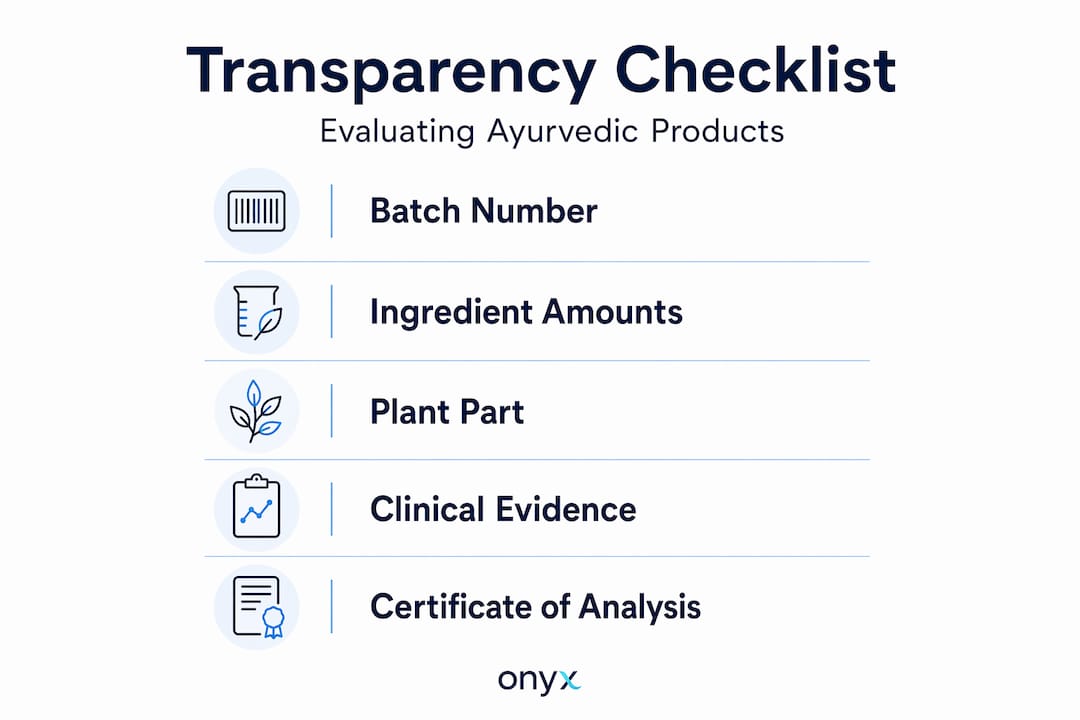
Here’s a practical checklist you can use in the aisle or on a product page:
- Check the plant part: Does it say root, leaf, seed, or bark? If not, ask.
- Look for standardization: Does the label declare active compound percentages?
- Find the batch number: Is it printed on the packaging so testing records can be traced?
- Search for third-party testing: Does the brand publish CoAs or have a recognized certification?
- Evaluate the dosage: Does the amount listed match what research studies have actually used?
- Read the claims carefully: “Supports relaxation” is allowed without much evidence. “Clinically proven to reduce cortisol” requires more scrutiny.
Wellness users should verify batch traceability and treat “science-backed” language with appropriate skepticism unless the evidence clearly aligns with the exact ingredients and doses used in that product.
Pro Tip: When a product page or label cites a study, look up whether that study used the same form, dose, and delivery method as what you’re buying. Many claims reference broad category research while using a generic ingredient that was never directly tested.
A good Ayurvedic relaxation support resource will walk you through these distinctions in real product contexts, and building a routine for clarity works best when the ingredients you’re relying on are well-documented and traceable.
The science and tradition of relaxation: Clarity from transparency
Finally, to tie everything together, let’s look at how transparency benefits you whether you value clinical studies, traditional wisdom, or both.
Modern research does support certain Ayurvedic interventions for relaxation and mental clarity. A study on yoga and Ayurveda for managing insomnia found measurable benefits, but also highlighted that standardization of the extract and dose is a key variable. In other words, the intervention worked when it was well-defined. Vague applications of traditional herbs, without specifying form or quantity, produced less reliable results.
At the same time, Ayurveda’s holistic mental health approach emphasizes individualized guidance. What works for one person may not be the right fit for another, and transparent, personalized instructions acknowledge that nuance. A brand that simply says “take two capsules for calm” gives you less to work with than one that explains the reasoning, the evidence, and how their formula connects to specific wellness goals.
What this means practically:
- Look for brands that explain both the traditional use and their modern evidence base
- Be open to the fact that some Ayurvedic practices are well-researched and others await more clinical study
- Use transparency as a filter: better-documented products give you more reliable, personalized outcomes
- Understand that individualized wellness is supported when you know exactly what you’re taking
Supporting your Ayurvedic balance and health goals depends on this kind of clarity. Tradition is valuable, but tradition paired with honest documentation is something you can actually build a wellness routine around.
Why “proven transparency” is more valuable than pretty labels
Here’s a hard-won lesson about transparency, marketing, and what really matters when you make choices for your wellness.
The supplement industry has gotten very good at looking transparent. Clean white packaging, short ingredient lists, earthy fonts, and phrases like “nothing to hide” or “full-spectrum transparency” have become aesthetic choices as much as ethical ones. That’s not cynicism. It’s a pattern worth recognizing.
Real transparency is harder to fake because it requires something more demanding than good design. It requires accurate labeling and substantiated testing, and without those, what looks like transparency is just marketing dressed up in wellness language.
This is the trap: when a brand adopts the language of transparency without the substance, it can actually create more confusion. You feel informed because the label looks open and honest. But the information you’re reading hasn’t been independently verified, the standardization claims haven’t been tested, and the “clinical research” cited applies to a different dose of a different form of the ingredient. You made a decision under the illusion of clarity.
Consumers who look past labels and dig into the actual evidence, the specific extract, the documented dose, the third-party records, are doing something that genuinely protects their wellness. They’re treating transparency as a practice rather than an aesthetic.
At Onyx Wellness, we believe this matters enough to talk about directly. A sustainable wellness workflow isn’t built on products that merely look clean. It’s built on products you can trace, question, and verify. That’s the kind of transparency worth demanding.
Explore transparent, trusted wellness with Onyx
If you’re ready to turn insight into action, here’s where you can find the kind of transparent solutions we’ve been talking about.
At Onyx Wellness, every product is built with a commitment to real transparency, standardized ingredients, clear sourcing, and rigorous quality control. Whether you’re looking for support to wind down at the end of a long day or sharpen your mental focus, our formulas are designed to give you the documented confidence to actually trust what you’re taking. Our Reishi Relax Gummies bring Ayurvedic tradition together with modern verification, and our Mushroom Extract Complex delivers clarity with the kind of traceability and standardization detail this article has been unpacking. Explore the range and see what genuine transparency feels like.
Frequently asked questions
How can I verify the transparency of an Ayurvedic supplement?
Look for batch numbers, standardized ingredient declarations, Certificates of Analysis, and sourcing details on the label. Brands that offer these details publicly make it far easier to verify traceability signals and confirm that testing actually occurred.
Do all “transparent” wellness products guarantee effectiveness?
No. True effectiveness depends on standardization, clinical backing, and the match between listed ingredients and proven evidence. As FDA labeling guidance makes clear, claims must be substantiated and labeling must be accurate, but many products meet legal minimums without providing real clinical proof.
What should I ask before buying a supplement for relaxation or clarity?
Ask about the plant part used, the dosage, the form of the extract, and whether independent testing backs the product. Science-backed claims warrant skepticism unless the evidence clearly aligns with the actual material and dose in that formula.
Why does plant part transparency matter in Ayurveda products?
Different plant parts like root versus leaf can have meaningfully different safety profiles, chemical compositions, and levels of research support. Ashwagandha root vs. leaf debates show how undisclosed substitutions create real quality and trust concerns.
Is scientific evidence always available for Ayurvedic relaxation supplements?
Not always. Some interventions have supportive clinical studies, particularly when standardized and dosed appropriately, but many herb-based approaches still await more rigorous modern evidence, especially for individualized applications.