


TL;DR:
- Many supplements on the market lack transparency, leading to contamination, ingredient variability, and safety concerns.
- True transparency involves clear sourcing, accessible lab results, and verified testing, ensuring product efficacy and safety.
- Choosing transparent brands promotes better wellness outcomes and supports industry-wide improvements through consumer advocacy.
Most people assume that if a supplement sits on a shelf or appears on a trusted website, it has been verified for safety and accuracy. That assumption is understandably comforting, but it is not always supported by evidence. Studies on supplement quality have found meaningful contamination rates and ingredient variability even in products that carry confident label claims. For anyone using supplements to support mental clarity, recovery, or holistic wellness, that gap between what a label says and what a product actually contains is not a minor inconvenience. It directly affects your results, your safety, and your ability to make informed choices.
Table of Contents
- Why transparency matters in supplements
- The impact of transparency on effectiveness and safety
- How to spot truly transparent supplement brands
- The bigger picture: Transparency, wellness, and industry change
- Our take: Why transparency is the key to supplement success
- Find truly transparent supplements for your wellness routine
- Frequently asked questions
Key Takeaways
| Point | Details |
|---|---|
| Transparency prevents risks | Open disclosure of sourcing and testing reduces the chance of contaminated or mislabelled supplements. |
| Improved clarity and trust | Choosing transparent brands supports mental clarity and wellness with reliable ingredients. |
| Third-party validation matters | Independent testing offers real assurance beyond label claims for supplement safety and effectiveness. |
| Your choices spark change | Demanding transparency drives industry improvements and better consumer protection. |
Why transparency matters in supplements
Supplement transparency is not just a marketing phrase brands use to sound trustworthy. True transparency means a company can tell you exactly where an ingredient was grown or sourced, how it was processed, and what testing confirmed it meets quality standards at the batch level. It means lab results are accessible, not just referenced. It means you can trace what you are swallowing back to its origin.
When that level of openness is missing, you are essentially playing a label lottery. Hidden or mislabeled ingredients carry real risks: allergic reactions in sensitive users, ineffective dosing that wastes your money, or toxic contaminants that you would never knowingly consume. These are not rare worst-case scenarios. They are documented occurrences across supplement categories.
Consider what researchers found when examining Rhodiola rosea, a plant widely used for mental clarity and stress support. Biomarker concentrations varied considerably across commercially available products, and heavy metal contamination was detected in all capsular products analyzed. This is a single herb, popular and well-regarded, and yet the quality across products was inconsistent enough to be a concern. That finding should shift how you evaluate any supplement purchase.
What true supplement transparency looks like
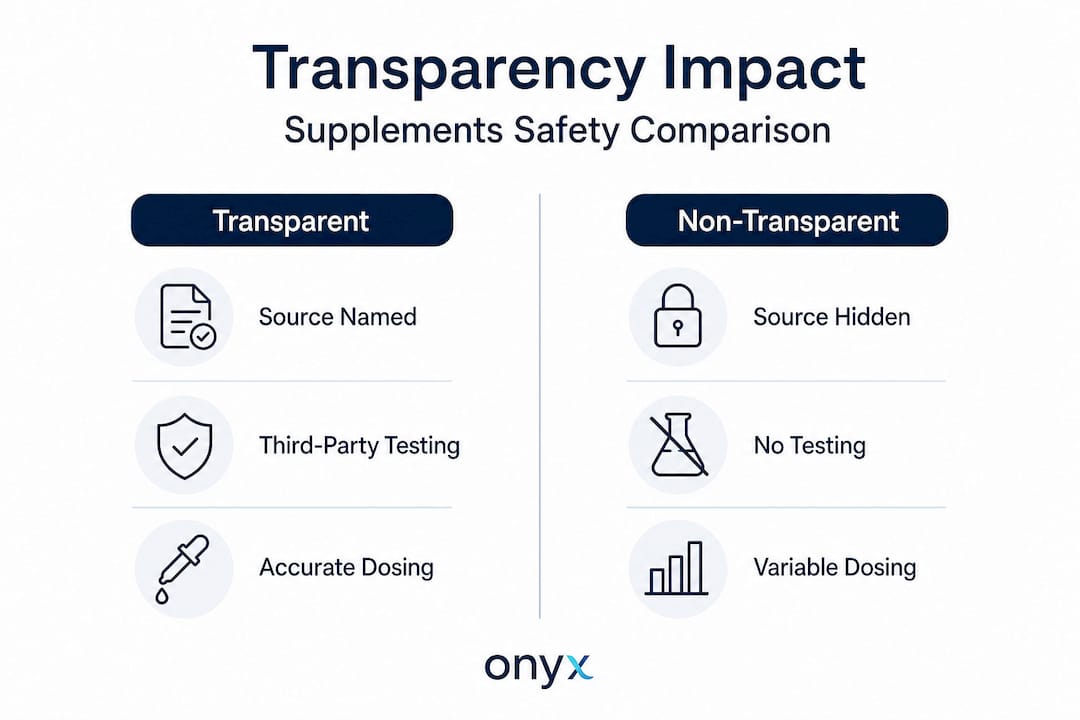
| Element | Transparent brand | Non-transparent brand |
|---|---|---|
| Ingredient sourcing | Named supplier and region disclosed | “Natural source” or unspecified |
| Batch testing | Published certificates of analysis | “Tested for quality” with no documentation |
| Contaminant screening | Heavy metals, microbials listed | Not mentioned |
| Third-party verification | Independent lab confirmation | Internal testing only |
| Proprietary blends | Broken down with individual doses | Grouped under a blend total |
The core elements of true transparency include open sourcing information, published batch numbers, accessible third-party lab results, and clear ingredient amounts rather than proprietary blend totals. When you are choosing safe supplement gummies or any other format, this checklist is your first filter.
Key red flags to watch for:
- “Proprietary blend” labels that hide individual ingredient amounts
- No batch number or lot number on packaging
- Claims of third-party testing with no certificate or lab name provided
- Vague sourcing descriptions like “botanical extract” without origin
- No contact information or FAQ section addressing quality control
A reasonable rule of thumb: if a brand cannot tell you where its ingredients come from, it probably cannot guarantee what is actually in the bottle.
The impact of transparency on effectiveness and safety
Once you understand what transparency means structurally, the next important question is: does it actually change your wellness outcomes? The short answer is yes, and the reasoning is straightforward.

Consistent ingredient quality produces predictable effects. When you take an adaptogen like ashwagandha or a functional mushroom extract and the actual concentration matches the label, your body receives what it needs to produce a measurable result. When that concentration is off, whether higher or lower than labeled, you either experience unexpected effects or none at all. That inconsistency makes it nearly impossible to know whether a supplement is working or whether it is simply unreliable.
The regulatory landscape does not fully protect you here. Unlike pharmaceuticals, dietary supplements in the United States are not required to prove safety or effectiveness before they reach market. The FDA can act after the fact if a product causes harm, but premarket review of supplements is limited. That gap makes the practices of individual brands and independent third-party certifiers more important than most people realize.
“Consumers should be vigilant about sourcing, ingredient traceability, and independent third-party validations, and calls for more frequent testing and improved quality control across the industry.”
This is not a fringe concern. It is a well-documented challenge that requires proactive consumer awareness to navigate effectively. For people specifically seeking energy and clarity benefits from natural greens or plant-based formulas, the difference between a transparently sourced product and one with undisclosed ingredients can be the difference between a noticeable wellness lift and an expensive placebo.
Comparing outcomes: transparent vs. non-transparent supplements
| Factor | With transparency | Without transparency |
|---|---|---|
| Dosing accuracy | Predictable, labeled amounts confirmed by testing | Variable, unverified |
| Mental clarity support | Consistent neurological support from verified active compounds | Uncertain, possibly negligible |
| Safety assurance | Contaminants screened and documented | Unknown risk level |
| Long-term trust | Built through repeatability | Fragile, dependent on hope |
| Wellness ROI | High, when formulas match tested results | Low to unpredictable |
If you are following Ayurvedic mental clarity tips and integrating traditional herbal compounds into your routine, transparency is what bridges ancient wisdom with modern accountability. Herbs like brahmi, lion’s mane, or Rhodiola carry centuries of use behind them, but that heritage only translates into real results when the product you hold in your hand actually contains what the label says.
Pro Tip: Before purchasing any supplement, search the brand’s website specifically for a “certificate of analysis” or “COA.” Transparent brands make this document easy to find. If you cannot locate it within a few clicks or a quick customer service inquiry, treat that as a meaningful warning sign.
How to spot truly transparent supplement brands
Knowing what transparency looks like in theory is helpful. Knowing how to identify it in the real world is what actually protects your health and your investment. Here is a practical step-by-step approach.
-
Check the label for full ingredient disclosure. Every ingredient should be listed individually with its dose. A blend listed as “200 mg proprietary formula” tells you nothing about whether any single ingredient is present in an effective amount.
-
Search for a certificate of analysis. This document, sometimes called a COA, is an independent lab’s report confirming that the product was tested and what it contains. Reputable brands publish these on their website or provide them on request.
-
Look for named third-party certifiers. Organizations like NSF International, USP (United States Pharmacopeia), or Informed Sport conduct rigorous independent audits. Their seal on a product carries weight because it represents real testing, not self-certification.
-
Verify the sourcing story. Does the brand tell you where its herbs or active compounds come from? Transparent companies often name their suppliers, specify the region of origin, and describe their harvesting or extraction methods.
-
Read the FAQ or transparency page. Many genuinely transparent brands dedicate a section of their website to answering the hard questions about quality control, testing schedules, and ingredient standards.
-
Contact customer support with a direct question. Ask where a specific ingredient is sourced or request a recent COA. The response time and quality of answer tells you a lot about a brand’s actual commitment to openness.
The same principles apply whether you are evaluating natural sports supplements for recovery or cognitive support formulas for focus. Transparency is not category-specific. It is a baseline standard that every wellness product should meet.
Common red flags in supplement marketing:
- “Clinically proven” with no study citation or link
- “Proprietary blend” with only a combined milligram total
- Testimonials as the primary form of evidence
- No physical address or verifiable company information
- Extremely low prices that make quality sourcing implausible
Pro Tip: Use the supplement company’s website to review testing certificates and sourcing FAQs before you add anything to your cart. Ingredient traceability and third-party validation are not extras; they are baseline expectations for any brand serious about your health.
The bigger picture: Transparency, wellness, and industry change
Your individual purchasing decisions are not made in a vacuum. When you consistently choose transparent brands, you are participating in a larger shift that pushes the entire supplement industry toward better standards. This is worth understanding, because it frames transparency not just as a personal health act but as a form of consumer advocacy.
Public demand for label accuracy and quality verification has historically driven regulatory improvements. The Dietary Supplement Health and Education Act of 1994 established baseline requirements, but the real acceleration in quality practices has come from consumer pressure and market competition among brands that want to earn trust. When buyers ask for COAs, reward transparency with loyalty, and reject products that cannot answer basic sourcing questions, brands respond.
Independent third-party testing organizations have grown in reach and credibility partly because consumers started demanding independent verification rather than accepting brand self-reporting. That shift matters. A brand that tests internally has an obvious conflict of interest. A brand that invites an independent lab to verify its products and publishes those results openly is making a different kind of commitment.
“The study concludes that calls for more frequent testing and improved quality control across the supplement industry are not just academic recommendations but practical consumer necessities.”
The positive changes that transparency advocacy has already sparked include:
- More brands voluntarily adopting third-party testing and publishing results
- Retailers adding “verified quality” filters to their shopping platforms
- Regulatory bodies increasing post-market surveillance of high-risk supplement categories
- Industry associations publishing best practice guidelines for labeling and sourcing
- Consumers gaining access to better educational resources on supplement safety
For people pursuing natural strategies for lasting health, these changes represent real progress. The more you understand about what drives quality in this space, the more power you have to choose well and encourage others to do the same.
Our take: Why transparency is the key to supplement success
Here is something we notice repeatedly: most people trust supplement labels not because they have verified them, but because questioning them feels like too much work. We get it. You are busy. You want a supplement that works. Doing a deep audit on every product you consider is not realistic for most wellness routines.
But here is the uncomfortable truth. The assumption that a well-designed label means a quality product is exactly the gap that some brands exploit. A label can be beautifully crafted with clinical-sounding language, high-resolution imagery, and confident efficacy claims while containing inconsistent doses, undisclosed fillers, or contaminants that no one tested for. The design of a label and the integrity of its contents are entirely separate things.
We have seen this play out most visibly in trending categories. When a specific ingredient category surges in popularity, whether that is adaptogens, nootropics, or functional mushrooms, the market floods with options of wildly varying quality. Some of those products are backed by genuine sourcing rigor and honest labeling. Others ride the trend without investing in the quality infrastructure that would actually make them effective or safe.
Finding genuinely transparent brands takes effort, especially in trending spaces. But the payoff is significant. When you know a product has been independently verified, that its active compounds are present in effective concentrations, and that contamination has been screened for, you can actually trust the results you experience. That is not a small thing. It is the difference between building a wellness routine that works and spending months and money on products that cannot deliver on their promises.
What we wish more people knew is that asking a brand direct questions about its quality practices is completely reasonable. A brand that is genuinely committed to transparency will welcome that question. It is the brands that deflect or give vague answers that should concern you. Pairing this vigilance with a focus on sustainable habits makes a real difference; if you are looking for a practical framework, this wellness workflow for busy professionals is a good place to see how transparency fits into a broader routine.
Pro Tip: Start by asking the hard questions of any brand you are considering. Ask them where their key ingredient is sourced, whether they publish COAs, and what their testing schedule looks like. A transparent brand will not hesitate. The willingness to answer openly is itself a meaningful signal.
Find truly transparent supplements for your wellness routine
If reading this has made you want to look more critically at what is already in your supplement cabinet, you are not alone. Many people reach this point and feel a mix of frustration and motivation. The good news is that there are genuinely transparent options available, and choosing them is a skill you can build quickly.
At Onyx Wellness, we built our product line around the belief that you should never have to guess what you are putting in your body. Our Ayurvedic-inspired formulas are designed with clean, traceable ingredients and crafted for people who want real results without the guesswork. From cognitive strips for focus and mental clarity to mushroom blends and holistic wellness support, every product reflects our commitment to openness about what goes into it and why. We invite you to explore our catalog and see what honest labeling and quality sourcing actually look like in practice.
Frequently asked questions
What does true supplement transparency mean?
True transparency means a brand openly shares sourcing, ingredient details, quality control results, and independent third-party testing for each supplement, not just on request but proactively as part of their standard practice.
How can I check if a supplement is truly transparent?
Look for listed sources, lab testing certificates, and a clear breakdown of ingredients on the company’s website or packaging; if those aren’t readily available, contact the brand directly and evaluate how they respond to sourcing and traceability questions.
Why is third-party testing so important for supplements?
Third-party testing catches contamination and verifies ingredient amounts, offering much stronger assurance than label claims alone because it removes the brand’s conflict of interest from the quality verification process.
Are there risks in supplements that look natural but aren’t transparent?
Yes, even natural-looking supplements can carry real risks; research found that heavy metal contamination appeared in all capsular Rhodiola rosea products tested, regardless of how those products were marketed or labeled.