


Creatine is one of the most studied supplements in sports nutrition, yet it still carries a cloud of outdated myths. People worry it dehydrates you, strains your kidneys, or only works for elite powerlifters. The reality is quite different. Meta-analyses confirm creatine does not cause dehydration or kidney harm in healthy adults. In fact, it actively supports hydration at the cellular level. This guide walks you through what creatine actually does inside your body, who benefits most, how to use it wisely, and why pairing it with proper hydration may be one of the smartest moves you make for your recovery routine.
Table of Contents
- How creatine works in your body
- Key benefits: Strength, muscle, and exercise performance
- Who benefits most, safety, and addressing myths
- Getting practical: How to use creatine wisely
- Why creatine’s real power is broader than muscle, and what most guides miss
- How Onyx Wellness can support your creatine and recovery journey
- Frequently asked questions
Key Takeaways
| Point | Details |
|---|---|
| Boosts muscle performance | Creatine increases energy for power, lifting, and high-intensity workouts. |
| Enhances recovery and hydration | It speeds muscle recovery and supports optimal cellular hydration. |
| Safe for most adults | Major studies confirm safety for kidneys and hydration when used properly. |
| Not just for athletes | Older adults, vegetarians, and wellness-focused individuals also benefit. |
| Pair with holistic routines | Creatine works best alongside resistance exercise and mindful nutrition. |
How creatine works in your body
Now that we’ve set aside old myths, let’s see how creatine actually functions inside your body.
Your body synthesizes creatine in the liver and also absorbs it from foods like steak, fish, and milk. About 95% of your total creatine supply is stored in skeletal muscle. That’s a significant concentration, and it tells you something important: your muscles are built to use this compound. The rest is found in smaller amounts in the brain, heart, and other tissues.
Once creatine reaches your muscles, it bonds with phosphate to form phosphocreatine (PCr). Think of PCr as a rapid-response energy reserve. During high-intensity exercise, your muscles burn through ATP (adenosine triphosphate), the primary fuel for muscular contraction, at a rate that your aerobic system simply can’t keep up with. That’s where the phosphocreatine system steps in, rapidly donating phosphate groups to regenerate ATP and keep your muscles firing hard for those critical extra seconds or reps.
Here’s a quick look at where creatine comes from naturally:
| Source | Creatine content (per 100g) |
|---|---|
| Herring | ~3.0g |
| Beef (steak) | ~2.0g |
| Pork | ~2.0g |
| Salmon | ~1.5g |
| Milk | ~0.1g |
| Plant foods | Negligible |
As you can see, getting meaningful amounts of creatine from food alone is challenging, especially if you’re plant-based. Supplementation fills that gap efficiently.
Key things creatine does at the cellular level:
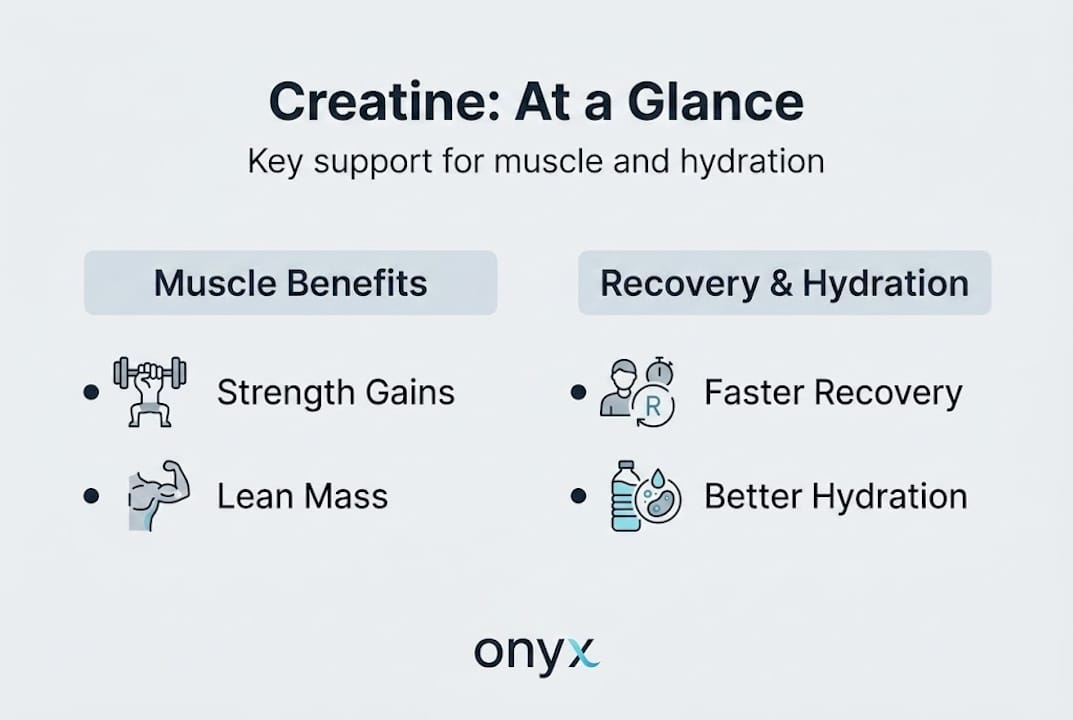
- Replenishes ATP faster during sprints, heavy lifts, and explosive movements
- Draws water into muscle cells, supporting cell volume and hydration
- May help buffer lactic acid buildup during intense training
- Supports protein synthesis pathways that contribute to muscle growth
“Most people eating a standard diet consume about 1 to 2 grams of creatine per day. Supplementation can raise muscle creatine stores by 20 to 40 percent above baseline, which is where the real performance gains begin.”
Pro Tip: If you follow a vegetarian or vegan diet, your baseline creatine stores are likely lower than those of meat eaters. This means you may respond even more noticeably to supplementation. Check out our sports nutrition guide for more context on how plant-based athletes can optimize their supplement strategy.
Key benefits: Strength, muscle, and exercise performance
Understanding how creatine works sets the stage. Let’s explore what this means for your performance, strength, and muscle gains.
The research here is genuinely impressive. Supplementation raises your muscle PCr stores, and the downstream effects are measurable. Studies show an average strength gain of around 8%, an increase of 1 to 3 kilograms in lean mass, and improvements in workout volume that can reach up to 45% more reps in some training protocols. Those aren’t marginal numbers.
Here’s how creatine stacks up against placebo in controlled research:
| Outcome | Creatine group | Placebo group |
|---|---|---|
| Strength increase | ~8% | ~2-3% |
| Lean mass gain | +1 to 3kg | Minimal |
| Sprint performance | Significantly improved | Minimal change |
| Workout volume (reps) | Up to 45% more | Baseline |
| Muscle cell hydration | Improved | No change |
| Recovery speed | Faster | Standard |
What’s worth noting is that creatine doesn’t just help during your workout. It also enhances post-exercise recovery and acts as an osmotic buffer, meaning it helps regulate fluid balance inside your muscle cells. That’s the hydration angle that most people overlook entirely.
When your muscle cells are better hydrated, they function more efficiently. Cell volumization, which is the process of drawing water into the muscle cell, signals anabolic (muscle-building) pathways and may reduce muscle breakdown after intense training. It’s a subtle but meaningful effect, and it’s one reason why creatine boosts training volume and cell hydration simultaneously rather than just giving you a short-term energy spike.
Here’s a numbered breakdown of the primary performance benefits:
- Increased power output during short, explosive efforts like sprinting or heavy compound lifts
- Greater training volume because you recover faster between sets, allowing more total work
- Improved lean muscle mass through a combination of better training stimulus and cellular hydration
- Faster recovery between sessions by reducing muscle damage markers and replenishing energy stores
- Better cellular hydration that supports muscle function and may reduce cramping risk
This is why pairing creatine with adequate hydration isn’t just a nice idea. It’s genuinely synergistic. A product that combines creatine with electrolytes and hydration support, like our HydraCore Creatine, addresses both the performance and recovery sides of the equation in one formula. When creatine draws water into muscle cells and you’re simultaneously replenishing electrolytes, you’re creating an environment where muscles can perform, repair, and grow more effectively.

Pro Tip: Pair creatine with consistent resistance training for maximum results. Creatine amplifies the stimulus your training provides. Without training, the gains are modest. With training, the compound effect is where the real transformation happens. Explore our muscle building with creatine collection for products designed around this principle.
Who benefits most, safety, and addressing myths
Seeing the big benefits, you might wonder: who really gets the most out of creatine, and is it safe for you? Let’s break it down.
Not everyone responds to creatine equally, and that’s worth being honest about. Research suggests that 20 to 30% of users are non-responders, meaning they see little measurable benefit. This is often because their baseline muscle creatine stores are already near capacity, which tends to happen in people who eat a lot of red meat regularly. Vegetarians, on the other hand, typically have more room to fill and tend to respond more dramatically.
Who benefits most from creatine supplementation:
- Vegetarians and vegans with lower dietary creatine intake and more room for muscle saturation
- Older adults who face natural muscle loss (sarcopenia) and need every advantage to maintain strength
- Athletes in strength and power sports like weightlifting, sprinting, football, and rowing
- Recreational gym-goers focused on progressive overload and body composition
- People recovering from injury where maintaining muscle mass during reduced activity matters
The older adult angle deserves special attention. Research shows that older adults gain an average of 2.1kg on their 1-rep max, lose fat, and improve functional performance when combining creatine with exercise. This isn’t just about aesthetics. It’s about maintaining independence, reducing fall risk, and supporting quality of life as you age. Creatine’s role here is genuinely meaningful and still underappreciated.
Now, let’s address the myths directly.
“Creatine does not damage kidneys in healthy adults. Multiple meta-analyses and long-term studies consistently show no adverse effects on kidney or liver function when creatine is used at recommended doses.”
The evidence is clear on safety: creatine does not cause dehydration, does not harm kidneys, and does not increase cramping risk in healthy individuals. The confusion often arises because creatine raises creatinine levels in the blood, and creatinine is a marker doctors use to assess kidney function. But elevated creatinine from creatine supplementation is a metabolic byproduct, not a sign of kidney stress. It’s a measurement artifact, not a warning sign.
If you have pre-existing kidney or liver disease, you should absolutely consult your doctor before starting any supplement. But for healthy adults, creatine has one of the strongest safety profiles in all of sports nutrition.
Emerging research is also beginning to explore creatine’s role in brain health and cognitive function, though this area needs more study before firm conclusions can be drawn. Our NovaCore Creatine is formulated with this broader wellness picture in mind.
Getting practical: How to use creatine wisely
With concerns and best practices covered, let’s focus on what you can do today for smarter supplementation.
The most well-researched dosing protocol involves two phases. First, a loading phase of 20 grams per day, split into four 5-gram doses across the day, for 5 to 7 days. This saturates your muscle stores quickly. Second, a maintenance phase of 3 to 5 grams per day to keep those stores topped off. Some people skip the loading phase entirely and just take 3 to 5 grams daily from the start. This approach takes about 3 to 4 weeks to reach full saturation, but it’s equally effective and gentler on the digestive system.
Here’s a practical step-by-step approach:
- Start with the maintenance dose if you’re new to creatine or have a sensitive stomach. Five grams per day is effective and well-tolerated for most people.
- Take it consistently, ideally at the same time each day. Timing relative to your workout matters less than consistency over weeks and months.
- Drink plenty of water throughout the day. Because creatine draws water into your muscles, staying well-hydrated supports this process and helps you feel your best.
- Pair with a recovery-focused routine that includes adequate protein, sleep, and stress management. Creatine works within a system, not in isolation.
- Consider Ayurvedic recovery herbs as complementary support. Adaptogens like ashwagandha have been used for centuries to support resilience and recovery, and they pair naturally with creatine’s performance benefits. Our Ayurvedic recovery tips blog covers this in more depth.
- Reassess after 8 to 12 weeks. Track your training volume, strength numbers, and how you feel during recovery. This gives you real data to personalize your approach.
Pro Tip: If you’re combining creatine with a hydration-focused formula, you’re giving your muscles a two-pronged advantage. Creatine saturates the muscle cell, and electrolytes help maintain the fluid balance that keeps those cells functioning at their best. This combination is especially valuable during periods of intense training or in hot weather when sweat losses are higher.
Why creatine’s real power is broader than muscle, and what most guides miss
Most creatine articles stop at muscle and strength. That’s the obvious story. But the more interesting conversation is about what creatine does for your whole-body wellness picture, and why that matters if you’re approaching health holistically.
The hydration angle alone changes the narrative. Creatine isn’t just a strength supplement. It’s an osmotic agent that actively supports cellular water balance. When your muscle cells are properly hydrated, you recover faster, feel less sore, and show up to your next session with more capacity. That’s a recovery story as much as a performance story.
Then there’s the emerging research on the brain. Studies exploring creatine’s brain benefits through the muscle-brain axis suggest that this compound may support cognitive resilience, particularly under conditions of sleep deprivation or mental fatigue. The brain, like muscle, relies on ATP, and creatine’s role in rapid energy replenishment doesn’t stop at the neck. This research is still developing, but it points toward creatine being a whole-body energy support tool rather than a single-system supplement.
What most guides miss is the integration piece. Creatine fits naturally within a holistic wellness practice when you treat it as one element of a broader system rather than a standalone fix. Pair it with quality sleep, adequate hydration, whole foods, and recovery-focused botanicals, and you’re building something sustainable. That’s the Ayurvedic-inspired approach we believe in: using what works, combining it thoughtfully, and supporting the whole person rather than just one metric.
Our natural supplements for recovery resource goes deeper on how to build this kind of integrated routine. The goal isn’t to chase short-term numbers. It’s to build a foundation that keeps you performing, recovering, and feeling well for the long term.
How Onyx Wellness can support your creatine and recovery journey
Ready to put this knowledge to work? Here’s how Onyx Wellness can help you take the next step.
At Onyx Wellness, we’ve built our supplement line around the idea that modern performance and ancient wisdom aren’t opposites. They’re partners. Our creatine product collection brings together thoughtfully formulated options designed for real recovery, not just gym-floor performance.

If you want to experience the synergy of creatine and cellular hydration together, our HydraCore Creatine is formulated specifically to support both. And if you’re thinking about your broader wellness routine, our Hair, Skin, and Nails Strips complement recovery from the inside out, supporting the connective tissue and cellular health that keeps your whole body resilient. We’re here to make your wellness journey feel supported, not overwhelming.
Frequently asked questions
Does creatine cause dehydration or kidney issues?
No. Research consistently shows creatine does not cause dehydration or harm your kidneys when used at recommended doses in healthy adults.
Who should avoid or be cautious with creatine supplements?
People with pre-existing kidney or liver disease should consult a doctor before taking creatine, but it’s safe for most healthy adults at standard doses.
How long does it take to see results from creatine?
Most users notice improved muscle energy and performance within one to two weeks of starting supplementation, especially if they use a loading protocol.
Does creatine work if you don’t exercise?
Creatine is most effective when combined with resistance or high-intensity training. Without training, the strength and muscle benefits are significantly reduced.
Can older adults use creatine safely?
Yes. Older adults can safely use creatine and often see meaningful benefits. Research shows increased strength and improved function when creatine is combined with regular exercise in this population.