


TL;DR:
- Functional mushroom gummies are non-psychedelic supplements made from legal fungi like lion’s mane and reishi, offering modest wellness benefits supported by science. Their effects on cognition, stress, and immunity develop gradually over weeks, with quality products verified through transparent labeling and third-party testing. Using these gummies responsibly involves realistic expectations, careful ingredient review, and choosing reputable brands to ensure safety and efficacy.
If you’ve seen mushroom gummies trending across wellness communities and wondered whether they’re somehow related to psychedelics, you’re not alone. That confusion is one of the most common misconceptions in the functional supplement space. The reality is that gummy mushrooms marketed for wellness are non-hallucinogenic supplements made from legal, functional fungi like lion’s mane and reishi, not psychedelic compounds. What follows is an honest, evidence-based look at what these products actually do, what the science supports, where the gaps are, and how to shop for them without getting burned.
Table of Contents
- What are gummy mushrooms and how do they work?
- Wellness claims: What’s real and what’s hype?
- Potential risks, side effects, and what to watch for
- How to choose quality mushroom gummies for your goals
- Our take: Why moderation, skepticism, and clarity matter most
- Explore quality wellness solutions with Onyx
- Frequently asked questions
Key Takeaways
| Point | Details |
|---|---|
| Functional, not psychedelic | Most gummy mushrooms use legal, non-psychedelic mushrooms for wellness—not ‘magic mushrooms’. |
| Evidence is promising but mixed | Clinical support exists for some ingredients and claims, though effects are subtle and research is still early. |
| Safety and transparency matter | Check for reputable sources, side effects, and clear labeling before choosing any mushroom gummy. |
| Aim for consistency | Gradual, daily use alongside other healthy habits is the most realistic path to results. |
| Match gummies to your goals | Pick formulations aligned with your priorities—relaxation, clarity, or recovery—and check supporting evidence. |
What are gummy mushrooms and how do they work?
Let’s clear the air first. Functional mushroom gummies are dietary supplements that contain extracts from specific fungi known for their potential wellness properties. They are not “magic mushrooms.” They don’t contain psilocybin. They won’t alter your perception or produce a high. What they do contain are bioactive compounds that researchers have been studying for decades, with growing interest in their role in immune function, cognitive health, and stress response.
Functional mushroom gummies typically contain legal, non-hallucinogenic mushrooms, with the most common being:
- Lion’s mane (Hericium erinaceus): Associated with cognitive support and nerve growth factor stimulation
- Reishi (Ganoderma lucidum): Traditionally used for relaxation, immune balance, and stress adaptation
- Cordyceps: Often linked to energy, endurance, and post-exercise recovery
- Chaga: Rich in antioxidants, studied for immune and anti-inflammatory support
- Adaptogens like ashwagandha: Frequently blended in to amplify stress-relief effects
The primary mechanism behind most of these benefits comes down to a class of compounds called beta-glucans (β-glucans). These are naturally occurring polysaccharides found in fungal cell walls. β-glucans act as immunomodulatory agents by binding to specific receptors on immune cells, helping regulate the body’s defensive response without overstimulating it. Think of them as a gentle calibration tool for your immune system rather than a blunt force activator.
So why choose gummies over capsules, powders, or teas? It comes down to convenience and consistency. Gummies are pre-dosed, portable, and genuinely enjoyable to take, which means you’re more likely to actually stick with them. Capsules can be more potent and easier to standardize, while powders offer flexibility in dosing. Teas are traditional but require preparation and often deliver lower concentrations of active compounds. The trade-off with gummies is that they sometimes contain lower mushroom extract doses to accommodate the gummy format, and added sugars or flavoring agents can affect the overall formula quality.
| Format | Taste | Convenience | Dosage control | Bioavailability |
|---|---|---|---|---|
| Gummies | High | Very high | Moderate | Moderate |
| Capsules | Neutral | High | High | Moderate to high |
| Powders | Variable | Moderate | High | High |
| Teas | Mild | Low | Low | Lower |
For a deeper look at how to navigate the mushroom gummies guide landscape before you buy, it helps to understand both the ingredients and the delivery format together.
Pro Tip: Always check whether a product lists the mushroom extract concentration (like 10:1 or 20:1 ratios) or just “mushroom powder.” Extracts are significantly more potent and bioavailable. If the label doesn’t specify, you’re likely getting a weaker product.
Having established what gummy mushrooms are (and are not), we can now examine the science behind their popular wellness benefits.
Wellness claims: What’s real and what’s hype?
Now that we know what’s in these gummies, let’s investigate whether their benefits live up to the marketing or the science. Spoiler: it’s somewhere in between.
The three most common claims you’ll see on mushroom gummy packaging are stress relief and relaxation, improved cognitive function and mental clarity, and immune system support. Each of these has a different level of scientific backing, and it’s worth knowing the difference.
Cognitive function (lion’s mane): This is arguably the most researched claim in the functional mushroom space. Randomized controlled trials on lion’s mane have focused on cognition, mood, and sleep quality, but the effects are not uniform across all studies and some participants do experience side effects. The most promising findings point to lion’s mane’s ability to stimulate nerve growth factor (NGF), a protein that supports the growth and maintenance of neurons. Early human studies show modest improvements in memory and focus, particularly in older adults. Results in younger, healthy populations are less consistent.
Stress relief and relaxation (reishi, ashwagandha): Reishi has a long history in traditional Eastern medicine as a calming adaptogen. Modern research supports some of this, particularly around its effect on cortisol regulation and sleep quality. Ashwagandha, an Ayurvedic staple, has stronger human trial evidence for reducing perceived stress and anxiety scores. When these two are combined in a gummy formula, the relaxation effect may be more noticeable than either ingredient alone.
Immune support (β-glucans, chaga): This is where the mechanistic evidence is clearest. β-glucans have well-documented interactions with immune receptors, and chaga’s antioxidant content is measurable. However, translating “immune modulation in lab settings” to “you’ll get sick less often” is a leap that the current body of human evidence doesn’t fully support yet.
| Ingredient | Primary claim | Evidence strength | Expected timeline |
|---|---|---|---|
| Lion’s mane | Cognitive clarity | Moderate (mixed RCTs) | 4 to 8 weeks |
| Reishi | Relaxation, sleep | Moderate | 2 to 6 weeks |
| Ashwagandha | Stress reduction | Moderate to strong | 4 to 8 weeks |
| Cordyceps | Energy, recovery | Preliminary | 3 to 6 weeks |
| Chaga | Immune, antioxidant | Preliminary | Variable |
| β-glucans | Immune modulation | Moderate (mechanistic) | Gradual |
“Expect subtle, gradual changes rather than dramatic shifts. Functional mushroom gummies work more like a slow tide than a sudden wave. Most people notice differences in sleep quality, stress resilience, or mental sharpness over weeks, not days.”
It’s also worth noting that US regulatory oversight for functional mushroom supplements is limited, meaning health claims on packaging are not pre-approved by the FDA. This doesn’t mean the products don’t work, but it does mean you can’t take marketing language at face value. Knowing how to choose the right mushroom gummies starts with understanding what the evidence actually says.
Here are the key things to keep in mind when evaluating wellness claims:
- Look for products that reference specific human clinical trials, not just animal or in vitro studies
- Understand that effect sizes in most mushroom supplement trials are modest, not dramatic
- Recognize that individual responses vary based on gut health, baseline stress levels, and lifestyle
- Be cautious of any product claiming to cure, treat, or prevent specific diseases
- Check whether reishi gummies for relaxation or other targeted formulas align with your specific wellness goal
Potential risks, side effects, and what to watch for
With those benefits in mind, it’s just as important to weigh potential risks and shop responsibly. Functional mushroom gummies are generally well-tolerated, but “generally” doesn’t mean “always.”

Human clinical studies on lion’s mane report possible side effects including gastrointestinal discomfort, loose stools, and headaches, particularly at higher doses or during the first few weeks of use. There is also at least one documented rare case of acute respiratory distress associated with prolonged, high-dose lion’s mane consumption. That’s an outlier, but it’s worth knowing.
Here are the most commonly reported side effects across functional mushroom gummies:
- Mild stomach discomfort or bloating, especially when taken on an empty stomach
- Loose stools or diarrhea, typically at higher doses
- Headaches, particularly during the initial adjustment period
- Skin rash in rare cases, possibly linked to mushroom allergies
- Interactions with blood-thinning medications (reishi has mild anticoagulant properties)
There’s also a more serious concern that goes beyond side effects: mislabeling. Retail “magic mushroom” gummies have at times been found to contain illegal psychedelic compounds, creating a genuine safety risk for unsuspecting consumers. This is especially common in products sold through gray market channels or with deliberately vague labeling designed to capitalize on the psychedelic trend without being explicit about it.
This is not a fringe problem. It’s a real and documented pattern in the unregulated supplement market. The best defense is knowing exactly where your products come from and what testing they’ve undergone.
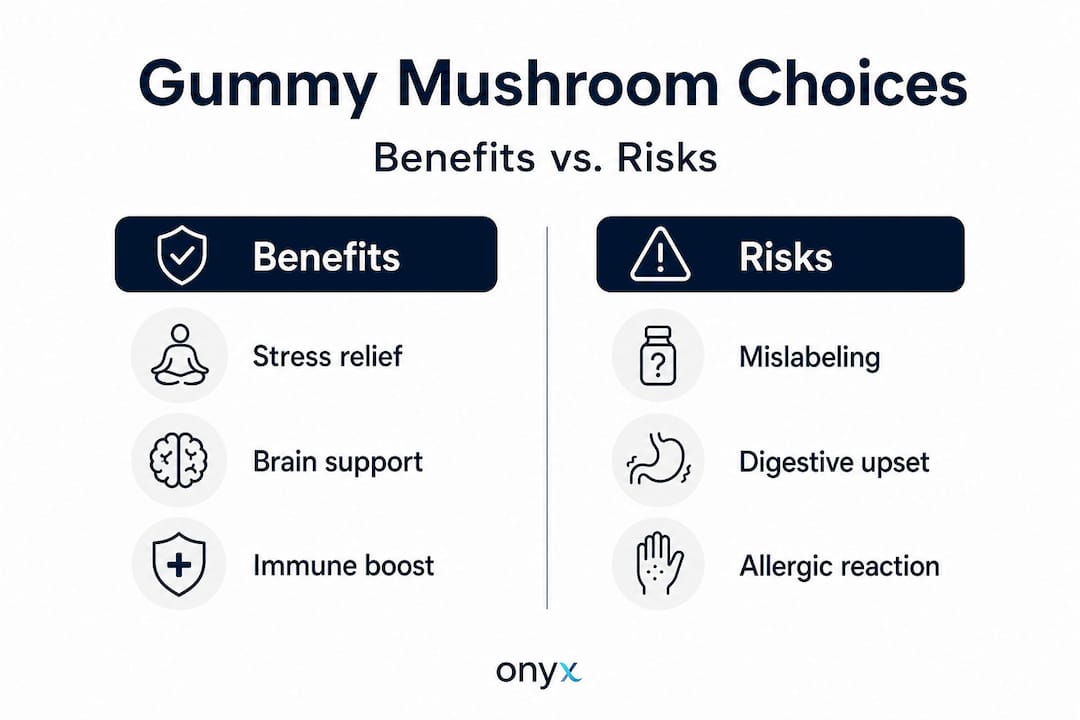
Pro Tip: Before purchasing any mushroom gummy, look for a Certificate of Analysis (COA) from a third-party lab. This document verifies the actual mushroom content, confirms the absence of contaminants like heavy metals and pesticides, and most importantly, confirms there are no undisclosed psychoactive compounds. If a brand won’t share its COA, that’s a significant red flag. For more on gummy safety tips, transparency is the single most important factor to evaluate.
How to choose quality mushroom gummies for your goals
Ready to make smart choices? Here’s how to pick the right mushroom gummies to match your wellness priorities.
The market is crowded, and not all products are created equal. A thoughtful selection process takes about ten minutes and can save you from wasting money or, worse, taking something that doesn’t match your health goals.
- Check ingredient transparency. Every mushroom species and adaptogen should be listed individually with its specific dose. Avoid proprietary blends that hide individual amounts behind a collective milligram total.
- Verify extract quality. Look for standardized extracts with listed ratios (e.g., 10:1) or confirmed β-glucan percentages. “Mushroom powder” without extraction details is a weaker, less reliable form.
- Confirm third-party testing. A COA from an independent lab is non-negotiable. It should test for potency, heavy metals, pesticides, and undisclosed substances.
- Match ingredients to your goal. Relaxation and stress response claims are best supported by reishi and ashwagandha. For cognitive clarity, prioritize lion’s mane. For recovery and energy, look for cordyceps and chaga with β-glucan content listed.
- Set realistic expectations. Most functional mushroom gummy effects are gradual and build over consistent use. Give any new product at least four to six weeks before evaluating its impact.
Red flags to avoid when shopping:
- Proprietary blends that don’t disclose individual ingredient amounts
- Claims of psychedelic, euphoric, or “microdosing” effects on legal products
- No third-party lab testing or refusal to share COA documentation
- Extremely low prices that suggest low-quality or diluted extracts
- Vague sourcing information with no mention of mushroom species or origin
- Dramatic “cure-all” language that promises results within days
If you’re also exploring broader wellness strategies, pairing mushroom gummies with Ayurvedic mental clarity practices can create a more holistic foundation for cognitive and emotional well-being.
Our take: Why moderation, skepticism, and clarity matter most
To bring it all together, here’s our perspective on what really matters with functional mushroom gummies.
We’ve seen a lot of wellness trends come and go. What makes functional mushrooms interesting isn’t that they’re miraculous. It’s that they’re genuinely ancient, genuinely studied, and genuinely misunderstood all at the same time. The problem isn’t the mushrooms. It’s the marketing machine that surrounds them.
Here’s the uncomfortable truth: most people who try mushroom gummies are looking for a shortcut. They want the calm without the meditation practice, the focus without the sleep discipline, the immune resilience without the lifestyle changes. And honestly, that’s understandable. Life is busy. But functional mushroom gummies work best when they’re part of a broader wellness approach, not a replacement for one.
The brands that are doing this right are the ones that tell you exactly what’s in their product, at what dose, backed by what evidence, and with what realistic expectations. They don’t promise you’ll feel transformed in 48 hours. They position their gummies as a consistent, supportive tool, like a good night’s sleep or a daily walk, something that compounds over time.
We also think the regulatory gap in this space is a real problem that puts consumers at risk. Until clearer standards exist, your best protection is your own discernment. Read labels carefully. Ask for lab reports. Choose brands that lead with transparency rather than hype.
Functional mushrooms, when used thoughtfully and sourced responsibly, can be a meaningful addition to a wellness routine. Pairing them with Ayurvedic wellness practices that have centuries of use behind them makes even more sense. The goal isn’t to replace one approach with another. It’s to build a layered, sustainable foundation for how you feel day to day.
Explore quality wellness solutions with Onyx
If you’ve made it this far, you already know more about functional mushroom gummies than most people who buy them. That knowledge is your best asset. Now the question is where to find products that actually live up to the standards you’ve just learned to look for.
At Onyx Wellness, we believe that transparency isn’t a bonus feature. It’s the baseline. Our formulas are built around evidence-backed ingredients at meaningful doses, clearly labeled and third-party tested. Whether you’re drawn to the calming properties of our Reishi Relax Gummies or the broader adaptogenic support of our Mushroom Extract Complex Gummies, you’ll know exactly what you’re getting and why it’s in there. No guesswork, no hype, just thoughtful formulation rooted in both Ayurvedic tradition and modern science.
Frequently asked questions
Are gummy mushrooms safe to take daily?
Most functional mushroom gummies are considered safe for daily use, though long-term data specific to the gummy format is still limited. Some people experience mild digestive side effects, particularly during the first few weeks, as functional mushrooms can occasionally cause stomach discomfort or headaches.
Do mushroom gummies make you feel high or cause psychedelic effects?
No. Functional mushroom gummies contain non-hallucinogenic mushrooms and will not produce any psychoactive effects. Products that claim otherwise are either mislabeled or may contain illegal substances.
Which mushroom gummies are best for relaxation?
Relaxation and stress response are best supported by reishi and adaptogens like ashwagandha, which have the most consistent human evidence for calming effects and cortisol regulation.
Can mushroom gummies really help my immune system?
Certain mushrooms contain β-glucans that support immune modulation through specific immune receptors, providing the clearest mechanistic rationale for immune support. Effects are gradual and depend heavily on product quality and consistent use.
What should I check before buying mushroom gummies?
Always review the ingredient list for specific doses, confirm third-party lab testing with a COA, and avoid products making dramatic or psychedelic claims. Label misrepresentation is a known risk in the mushroom supplement market, so sourcing from transparent, reputable brands is essential.