


TL;DR:
- True mental clarity depends on sleep, stress management, movement, and lifestyle choices rather than quick supplement fixes. Supporting brain health holistically through daily habits fosters sustained focus and decision-making capacity over time. Targeted botanicals can aid specific needs but are most effective when combined with consistent, foundational routines.
You’ve probably seen the ads: “One capsule for laser focus!” or “Feel sharper in 30 minutes!” It’s tempting to believe that mental clarity is just a supplement away. But if that were true, everyone would be operating at their peak every single day. The reality is that true mental clarity isn’t a switch you flip. It’s a state your brain and body arrive at together, shaped by sleep, stress, movement, and yes, sometimes the right botanical support at the right time. Understanding this distinction is what separates short-term hope from long-term results.
Table of Contents
- What does ‘mental clarity’ mean and why does it matter?
- How Ayurveda frames mental clarity: Sattva and holistic context
- What works and what doesn’t: Evidence on natural supplements for mental clarity
- A practical framework for supporting your mental clarity naturally
- Why chasing instant clarity misses the real opportunity
- Discover Ayurveda-inspired support for your daily clarity journey
- Frequently asked questions
Key Takeaways
| Point | Details |
|---|---|
| Mental clarity is holistic | Sustainable clarity depends on your whole lifestyle, not just one supplement or hack. |
| Evidence over hype | Science shows most supplements offer targeted benefits like reduced stress, not instant sharpness. |
| Ayurvedic wisdom is practical | Ayurveda combines routine, mind-management, and botanicals to build clear thinking over time. |
| Start with daily habits | Prioritize sleep, physical activity, and stress relief to create the strongest foundation for clarity. |
| Set real expectations | Clarity is gained by supporting brain health and habits, not just trying trending ingredients. |
What does ‘mental clarity’ mean and why does it matter?
Mental clarity isn’t just “feeling sharp.” It’s the ability to think efficiently, make sound decisions under pressure, and sustain focused attention through tasks that actually matter. Think of it as your brain running smoothly rather than grinding through fog. When clarity is high, you prioritize well, process information faster, and feel more in control of your day.
Here’s why that matters beyond just productivity. Research consistently shows that upstream brain-state factors like attention, sleep quality, stress load, and exercise directly shape how efficiently people think and decide across their lifespan. This is especially important as you age, since cognitive resilience doesn’t happen by accident. It’s built through daily choices that either support or erode brain health over time.
“Mental clarity is not a fixed trait you either have or lack. It’s a dynamic state that reflects the quality of your sleep, your stress levels, your movement habits, and your relationship with your own mind.”
The good news? Most of the factors that determine your clarity are things you can actually influence. Here’s a snapshot of the key determinants and how they interact:
| Factor | How it affects mental clarity | Actionable lever |
|---|---|---|
| Sleep quality | Consolidates memory, clears metabolic waste | Consistent sleep schedule, dark room |
| Stress level | High cortisol impairs prefrontal function | Breathwork, mindfulness, adaptogens |
| Physical exercise | Stimulates BDNF, improves blood flow | 30 min moderate movement, 4-5x per week |
| Attention habits | Fragmented focus depletes working memory | Intentional single-tasking, tech limits |
| Nutrition | Affects neurotransmitter production | Whole foods, hydration, micronutrients |
Exploring natural strategies for better focus often starts with this table. Not because supplements don’t play a role, but because these five levers are where the real leverage lives. If your sleep is chaotic and your stress is unmanaged, no nootropic is going to close that gap meaningfully.
It’s also worth noting that exercise and brain health are more tightly connected than most people realize. Regular aerobic activity boosts levels of brain-derived neurotrophic factor (BDNF), a protein that supports neuron growth and protects existing neural pathways. This is not a minor effect. It’s one of the most reliable cognitive supports available, and it’s free.
How Ayurveda frames mental clarity: Sattva and holistic context
With a scientific understanding in mind, let’s explore how Ayurveda, one of the world’s oldest holistic health systems, conceptualizes and supports true mental clarity. Ayurveda doesn’t separate the mind from the body. It treats them as one interconnected system, and that framing turns out to be remarkably consistent with what modern neuroscience is finding.
In Ayurvedic philosophy, mental clarity is associated with Sattva, a quality of the mind characterized by purity, balance, calmness, and clear perception. When Sattva dominates, your thinking is lucid, your emotions are stable, and your decision-making is sound. When the mind is clouded by Rajas (excessive activity and distraction) or Tamas (inertia and dullness), clarity suffers.
Supporting Sattva isn’t about one herb or one habit. According to Ayurvedic principles around Sattva, supporting mental clarity involves aligning lifestyle, diet, and mind-management practices, including a therapeutic approach called Satvavajaya, which aims to restrain unwholesome mental stimuli and redirect the mind toward balance. This is essentially an ancient form of cognitive restructuring.
Ayurveda also recognizes three fundamental biological energies called doshas: Vata, Pitta, and Kapha. Each person has a unique combination of these, and imbalances in any one of them can manifest as mental fog, anxiety, or low motivation. For example:
- Vata imbalance: scattered thinking, forgetfulness, difficulty focusing
- Pitta imbalance: mental burnout, irritability, overthinking
- Kapha imbalance: mental heaviness, slow processing, difficulty motivating
You can read more about applying these ideas practically through Ayurvedic mental clarity tips that bridge ancient concepts with daily habits you can actually build. The Satvavajaya Chikitsa approach has also been studied in clinical contexts for its nootropic potential, with promising indicators for attention and mental performance.
Here’s a useful comparison between a “pill-based” approach and a holistic Ayurvedic-inspired approach:
| Approach | Goal | Method | Realistic outcome |
|---|---|---|---|
| Supplement-only | Fast clarity boost | Single supplement | Subtle, specific, often short-term |
| Holistic Ayurvedic | Sustained Sattva | Routine, diet, herbs, mind work | Gradual, broad, and durable |
| Integrated approach | Both acute and long-term | Evidence-based habits plus targeted botanicals | Most reliable for most people |
If you want to boost mental wellness with Ayurveda, the most effective starting point is usually your daily routine. A structured morning, consistent sleep schedule, and a few intentional moments of stillness can shift your baseline clarity more than most supplements can. Pair that with an Ayurvedic home routine for mental clarity and you’ve built a real foundation.

What works and what doesn’t: Evidence on natural supplements for mental clarity
But does taking a natural supplement guarantee more focus or sharper thinking? Let’s break down what the science really says, because the marketing and the research are often telling two very different stories.
Bacopa monnieri is one of the most studied Ayurvedic nootropic herbs. It has genuine evidence for supporting memory formation and reducing anxiety, particularly with extended use over eight to twelve weeks. But clinical reviews on Bacopa show mixed results, especially when it comes to broad clarity or focus benefits across all users. The effects are real but specific, not a universal mental upgrade.
Ashwagandha (Withania somnifera) is another standout. It has solid evidence for reducing perceived stress and anxiety, supporting sleep quality, and improving some markers of cognitive performance in stressed individuals. But research on Ashwagandha’s effects on anxiety and cognition consistently points to targeted benefits rather than broad cognitive enhancement for people who are already mentally healthy and well-rested.
Ginkgo biloba has a long history of use for memory and circulation. Evidence here is more inconsistent, with some trials showing benefits for older adults or those with early cognitive decline, and minimal effects in healthy younger adults.
Here’s the key distinction you should carry with you: stress and fatigue reduction is not the same as cognitive enhancement. When a botanical helps you feel clearer, it’s often because it has reduced a disruptor (like anxiety or poor sleep), not because it has directly upgraded your processing power. That’s still valuable. But it reframes what you should expect.
- Check what the supplement actually targets. Stress? Sleep? Energy? These are legitimate and valuable. “Broad focus boost” is usually marketing shorthand.
- Look at trial populations. Benefits shown in sleep-deprived or highly stressed individuals may not apply to someone already sleeping well.
- Notice timing and dosage. Many botanicals require consistent use over weeks before effects appear. Instant clarity from a botanical is almost always overstated.
- Verify outcome claims. Ask whether the study measured actual cognitive tasks or just subjective ratings. Both matter, but they tell different stories.
- Consider the role of gut health and nutrition. Reading about daily greens and clarity highlights that broad nutritional support often underpins how well targeted herbs perform.
Pro Tip: If you’re going to try a botanical supplement, pick one with a specific target, like stress reduction or sleep quality, not a “complete brain formula.” Targeted support with realistic expectations tends to deliver more satisfaction than chasing a big promise.
Functional mushrooms like Lion’s Mane are also gaining traction in evidence-based cognitive support circles. Lion’s Mane contains compounds called hericenones and erinacines that may stimulate nerve growth factor production, supporting brain plasticity. Early studies are promising, particularly for focus and memory over time. Products like Mushroom Focus Strips offer a modern delivery method for these compounds, designed for convenience and fast absorption.
Research into physical activity for memory also shows that movement remains one of the most consistently effective and underused tools for cognitive support, outperforming most supplements in head-to-head comparisons.
A practical framework for supporting your mental clarity naturally
Having explored what the evidence really says, let’s turn those insights into an actionable toolkit for supporting your own mental clarity. This isn’t about perfection. It’s about building a reliable environment for your brain to function at its best.
The core insight from both Ayurveda and neuroscience is that clarity is a downstream result of reducing cognitive disruptors and consistently supporting the fundamentals. Think of it less like installing an upgrade and more like removing friction.
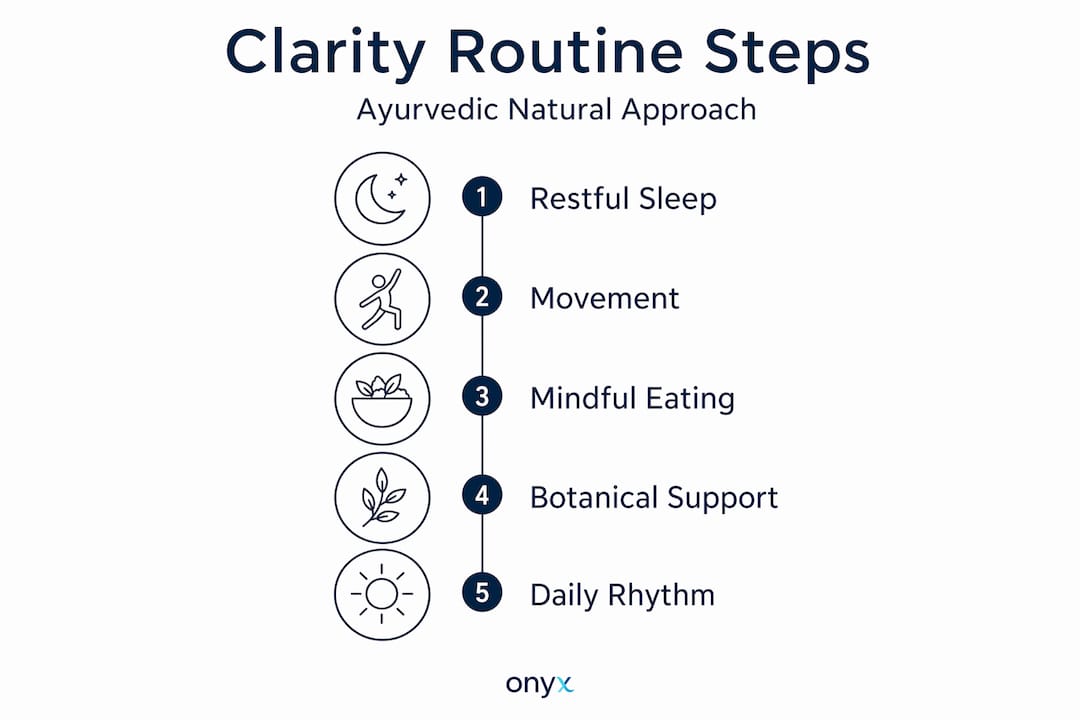
- Protect your sleep first. Seven to nine hours of quality sleep isn’t optional. It’s when your brain consolidates learning, clears cellular waste, and resets stress hormones. No supplement compensates for chronic sleep debt.
- Move your body daily. Even a 20 to 30 minute brisk walk increases cerebral blood flow and BDNF. You don’t need a gym. You need consistency.
- Anchor your day with a morning routine. Ayurvedic tradition recommends starting the day without screens, with intentional movement or breathwork, and a nourishing breakfast. Western chronobiology supports the same idea: early morning light exposure and low-stress starts set a stable neurological tone for the day.
- Manage stress as an active practice. Sustained stress elevates cortisol, which directly impairs the prefrontal cortex, the part of your brain responsible for focus and decision-making. Meditation, nature time, breathwork, and even light social connection all help regulate this.
- Add targeted botanical support where the evidence fits. If you’re dealing with stress-related fog, adaptogens like Ashwagandha may help. If sleep is the weak link, botanicals targeting sleep quality are a logical fit. Check out Cognitive Relax Strips for a convenient, dissolvable option designed around this principle.
Pro Tip: Build your clarity routine in layers. Start with sleep and movement for two weeks before adding any botanical. This way, if your clarity improves, you’ll know which variable is actually doing the work.
Reviewing Ayurveda tips for relaxation can help you fill in the gaps around stress management and daily rhythm. The ancient framework and the modern evidence are pointing in the same direction. Consistency over intensity. Process over product.
Why chasing instant clarity misses the real opportunity
Here’s a perspective worth sitting with: the supplement industry has trained many of us to associate mental clarity with consumption. Take this, feel that. It’s a compelling story, but it’s also why so many people cycle through products without ever landing on something that actually works for them long-term.
Cognitive enhancer reviews caution that enhancement expectations often outstrip the evidence, especially for healthy individuals. The effects that do exist are usually specific, context-dependent, and unlikely to generalize to broad day-to-day intelligence gains. That’s not a pessimistic view. It’s actually liberating, because it shifts the focus back to where the real opportunity is.
What actually works for lasting clarity is building a brain-healthy lifestyle and then using targeted tools, botanical or otherwise, to address specific gaps. The people who report the most consistent mental clarity aren’t usually the ones with the most sophisticated supplement stacks. They’re the ones who sleep well, move regularly, manage their stress with intention, and use herbal support thoughtfully.
Both ancient wisdom and modern science agree on this point in ways that should make us pay attention. Ayurveda has always treated clarity as a cultivated state, not a purchased one. And if you look at realistic expectations for cognitive support, the evidence broadly confirms that framing. The opportunity isn’t in finding the right pill. It’s in building the right conditions.
Discover Ayurveda-inspired support for your daily clarity journey
Ready to turn knowledge into routine? Here’s how you can continue your clarity journey with confidence.
Onyx Wellness was built for exactly this kind of intentional, holistic approach. We fuse traditional Ayurvedic principles with modern, convenient delivery formats so that supporting your mental clarity actually fits into real life.

If you’re focused on sharpening your attention and supporting cognitive energy, our Mushroom Focus Strips are a great place to start, featuring functional mushroom extracts in a fast-absorbing, dissolvable format. If stress-related fog is what holds you back, our Cognitive Relax Strips target the calm-and-clear intersection that both Ayurveda and neuroscience prioritize. No water needed. No guesswork. Just clean, purposeful support for the clarity work you’re already doing.
Frequently asked questions
Can a single supplement give me instant mental clarity?
No. Current evidence shows that supplements offer specific, subtle benefits rather than instant, broad clarity, especially in already-healthy individuals. Most require consistent use over several weeks to show any meaningful effect.
What are the most important daily habits for supporting mental clarity?
Prioritize quality sleep, regular exercise, effective stress management, and a consistent daily routine. Research shows that upstream factors like sleep and exercise shape cognitive performance more reliably than any supplement.
Does Ayurveda offer practical tools for everyday mental clarity?
Yes. Ayurveda integrates lifestyle, diet, and mind-management practices like Satvavajaya to support mental clarity holistically, addressing root causes rather than symptoms alone.
Will using botanicals or supplements make me smarter?
For most healthy people, botanicals may support stress reduction or energy, but effects are specific and context-dependent and rarely lead to broad intelligence gains across the board.
What’s the first step if I want sustainable mental clarity?
Focus on consistent brain-healthy behaviors first, especially improving sleep, daily movement, and stress management. Clarity follows from reducing cognitive disruptors, and supplements work best as support on top of that foundation rather than a replacement for it.